The LA Times has a great article and video about the recovery of the green sea turtle recovered from the San Gabriel River.
Seems like the poor thing suffered a lot of abuse before it was rescued!
Friday, October 24, 2008

Monday, September 15, 2008
University by the Sea
It's nearly time for the second annual University by the Sea!
Saturday, October 5, 10 AM to about 6 or 7.
This is a day-long event hosted by Cal State Long Beach in the downtown/east village area. Local luminaries teach classes on various subjects relating to Long Beach, including several classes of interest to environmentally minded folk.
Here are the highlights:
Session 1: 10 - 11 AM.
Breakwater 101
Breakers Building - Wedding Chapel · $5
Surfrider Foundation & 4th District Councilman Patrick O' Donnell, City of Long Beach
Come learn about the Long Beach breakwater - from past to present! Surfrider Foundation will share the breakwater's history - when and why it was built - and discuss how a breakwater configuration could help solve our local water-quality problems. 4th District Councilman Patrick O' Donnell will describe the Army Corps of Engineers Reconnaissance Study process.
Session 2: 11:30-12:30
Plants and People
Utopia Restaurant · $5
Jorge Ochoa, Horticulture Instructor, Long Beach City College
Lecture discussing the benefits of plants to human kind. How plants have shaped people's lives throughout history. To value and understand the life of plants, structure, and functions.
What it Means to be "Green"
Gotama Building Engineers · $5
Nikolas Bruno & Kacie McLamb, Engineers, Gotama Building Engineers Inc.
An academic class on sustainability and a guided tour of a sustainable building.
Session 3: 1-2 PM
Pollution in our Seas - What Happens to the Fish?
Lafayette Building - Tuna Room · $5
Kevin M. Kelley, Professor/Lab Director, CSULB Department of Biological Studies
Powerpoint-based lecture with props for a close-up interactive discussion on how pollution and contaminants impact wildlife in the marine and coastal environment.
Sustaining Your Backyard Garden
East Village Community Garden · $5
Staff, Long Beach Organic
A three-part lecture and Q&A on sustainable living in your backyard: (1) The Apple Guild, (2) Composting, (3) Making the Yard a Wildlife Habitat
What it Means to be "Green"
Gotama Building Engineers · $5
Nikolas Bruno & Kacie McLamb, Engineers, Gotama Building Engineers Inc.
An academic class on sustainability and a guided tour of a sustainable building.
Session 4: 2:30 - 3:30
Green Shopping Guide
Breakers Building - Wedding Chapel · $5
Russ Parsons, Author, "How to Pick a Peach"
Learn the basics of "eat local: eat seasonal" and how shopping at local farmer's markets can lead to better quality, better taste and better value.
Los Angeles River: History, Present & Future
Lafayette Building - Dome Room · $5
Alicia Katano, Education Coordinator, Friends of the L.A. River (FoLAR)
Impacts of urban run-off on river habitat and revitilization projects explored by the front-line fighters for a better L.A. River.
What it Means to be "Green"
Gotama Building Engineers · $5
Nikolas Bruno & Kacie McLamb, Engineers, Gotama Building Engineers Inc.
An academic class on sustainability and a guided tour of a sustainable building.
Session 5: 4-5
Beyond Xeriscape
Utopia Restaurant · $5
Kathleen Thomas, Designer/Horticulturist, CSULB Extension Services
A practical guide to having plants in your life - no matter what color thumb you have. Learn how to create a sustainable, low water use, organic garden, that is simple to care for and looks great!
Session 6: 5:30 - 6:30
Califlora: The Importance of Promoting Native Landscaps in Urban Areas
Utopia Restaurant · $5
Eric Zahn, Plant Ecologist, CSULB
Will demonstrate what native plants are for use in urban gardens and the services they provide. Will do demo on how to care for native plants.
Saturday, October 5, 10 AM to about 6 or 7.
This is a day-long event hosted by Cal State Long Beach in the downtown/east village area. Local luminaries teach classes on various subjects relating to Long Beach, including several classes of interest to environmentally minded folk.
Here are the highlights:
Session 1: 10 - 11 AM.
Breakwater 101
Breakers Building - Wedding Chapel · $5
Surfrider Foundation & 4th District Councilman Patrick O' Donnell, City of Long Beach
Come learn about the Long Beach breakwater - from past to present! Surfrider Foundation will share the breakwater's history - when and why it was built - and discuss how a breakwater configuration could help solve our local water-quality problems. 4th District Councilman Patrick O' Donnell will describe the Army Corps of Engineers Reconnaissance Study process.
Session 2: 11:30-12:30
Plants and People
Utopia Restaurant · $5
Jorge Ochoa, Horticulture Instructor, Long Beach City College
Lecture discussing the benefits of plants to human kind. How plants have shaped people's lives throughout history. To value and understand the life of plants, structure, and functions.
What it Means to be "Green"
Gotama Building Engineers · $5
Nikolas Bruno & Kacie McLamb, Engineers, Gotama Building Engineers Inc.
An academic class on sustainability and a guided tour of a sustainable building.
Session 3: 1-2 PM
Pollution in our Seas - What Happens to the Fish?
Lafayette Building - Tuna Room · $5
Kevin M. Kelley, Professor/Lab Director, CSULB Department of Biological Studies
Powerpoint-based lecture with props for a close-up interactive discussion on how pollution and contaminants impact wildlife in the marine and coastal environment.
Sustaining Your Backyard Garden
East Village Community Garden · $5
Staff, Long Beach Organic
A three-part lecture and Q&A on sustainable living in your backyard: (1) The Apple Guild, (2) Composting, (3) Making the Yard a Wildlife Habitat
What it Means to be "Green"
Gotama Building Engineers · $5
Nikolas Bruno & Kacie McLamb, Engineers, Gotama Building Engineers Inc.
An academic class on sustainability and a guided tour of a sustainable building.
Session 4: 2:30 - 3:30
Green Shopping Guide
Breakers Building - Wedding Chapel · $5
Russ Parsons, Author, "How to Pick a Peach"
Learn the basics of "eat local: eat seasonal" and how shopping at local farmer's markets can lead to better quality, better taste and better value.
Los Angeles River: History, Present & Future
Lafayette Building - Dome Room · $5
Alicia Katano, Education Coordinator, Friends of the L.A. River (FoLAR)
Impacts of urban run-off on river habitat and revitilization projects explored by the front-line fighters for a better L.A. River.
What it Means to be "Green"
Gotama Building Engineers · $5
Nikolas Bruno & Kacie McLamb, Engineers, Gotama Building Engineers Inc.
An academic class on sustainability and a guided tour of a sustainable building.
Session 5: 4-5
Beyond Xeriscape
Utopia Restaurant · $5
Kathleen Thomas, Designer/Horticulturist, CSULB Extension Services
A practical guide to having plants in your life - no matter what color thumb you have. Learn how to create a sustainable, low water use, organic garden, that is simple to care for and looks great!
Session 6: 5:30 - 6:30
Califlora: The Importance of Promoting Native Landscaps in Urban Areas
Utopia Restaurant · $5
Eric Zahn, Plant Ecologist, CSULB
Will demonstrate what native plants are for use in urban gardens and the services they provide. Will do demo on how to care for native plants.
Sunday, September 7, 2008
Los Cerritos Channel
As you may know, green sea turtles were recently sighted swimming up the San Gabriel River. They were seen in the area of the Cerritos Channel, an arm of the San Gabriel River estuary. So of course I had to check it out! Sadly, no turtles were seen during my brief visit, but I thought I'd write it up on this blog, because this unlikely area was full of quite a few surprises.
View Larger Map
There is a small park along Cerritos Channel called Channel View Park.

The park is a highly manicured strip of lawn with a bike/pedestrian path, separated from the channel by an ugly chainlink fence. Opportunities to commune with nature here are limited, although if the scenery is appealing in that post-apocolyptic way that comes so easily in southern California:

The huge stacks of a powerplant dominate the landscape. The plant takes in water from the river to cool the engines, and returns heated effluent to the San Gabriel river. Both the intake and effluent have deleterious impacts on the marine environment, and these impacts are closely monitored by a number of agencies. The most severe impacts are the death of marine organisms on intake screens, and the alteration of the thermal regime of the river.
As I mentioned, the park itself doesn't offer much access to nature, though you can see quite a bit from the bridges over the channel on Loynes Drive and Studebaker.
Birdlife was somewhat abundant here, with several of the usual suspects:

Cormorants, either perched on the trash booms or here, flying in V-formation.

Great egret.
Not shown: belted kingfisher and great blue heron. The vacant lots around the channel show evidence of wild dogs--either strays, or perhaps coyotes!
The contrast between the graceful birds and the imposing industral backgrop can be quite jarring:

The bridge on Studebaker offers a glimps into muddier habitat than is typical of other parts of the channel, which are full of rocky riprap:

You can see long and elegant smelt swimming at the surface, or even jumping out.

The most exciting sighting of the day were two large-ish octopuses (or octopi--both are correct!) fighting in the shallow water! Sadly, I got no photos to show. But I will be sure to try again sometime soon!
View Larger Map
There is a small park along Cerritos Channel called Channel View Park.
The park is a highly manicured strip of lawn with a bike/pedestrian path, separated from the channel by an ugly chainlink fence. Opportunities to commune with nature here are limited, although if the scenery is appealing in that post-apocolyptic way that comes so easily in southern California:
The huge stacks of a powerplant dominate the landscape. The plant takes in water from the river to cool the engines, and returns heated effluent to the San Gabriel river. Both the intake and effluent have deleterious impacts on the marine environment, and these impacts are closely monitored by a number of agencies. The most severe impacts are the death of marine organisms on intake screens, and the alteration of the thermal regime of the river.
As I mentioned, the park itself doesn't offer much access to nature, though you can see quite a bit from the bridges over the channel on Loynes Drive and Studebaker.
Birdlife was somewhat abundant here, with several of the usual suspects:
Cormorants, either perched on the trash booms or here, flying in V-formation.
Great egret.
Not shown: belted kingfisher and great blue heron. The vacant lots around the channel show evidence of wild dogs--either strays, or perhaps coyotes!
The contrast between the graceful birds and the imposing industral backgrop can be quite jarring:
The bridge on Studebaker offers a glimps into muddier habitat than is typical of other parts of the channel, which are full of rocky riprap:
You can see long and elegant smelt swimming at the surface, or even jumping out.
The most exciting sighting of the day were two large-ish octopuses (or octopi--both are correct!) fighting in the shallow water! Sadly, I got no photos to show. But I will be sure to try again sometime soon!
Thursday, September 4, 2008
Colorado Lagoon Restoration

According to an article in today's Grunion Gazette:
The City's Planning Commission is set to certify the Enivornmental Impact Report (EIR) for restoration of Colorado Lagoon!
You can read the entire EIR, which describes the plan and all the expected impacts here:
link
The primary goal of the restoration is to address the poor water quality that afflicts the lagoon and often prevents swimming and other uses. For example, the EIR describes plans to improve storm drains so that pollutant-laden runoff only enters the lagoon in the largest rains.
However, restoration of natural areas is also included in the plans!
Several areas of wetlands will be formed along the margins of the lagoon, and a "bird island" will be created. Eel grass beds in the open water will be restored.
For more details, also check out the Friends of Colorado Lagoon.
Wednesday, September 3, 2008
Sea turtles in Long Beach!
The Press-Telegram has an article about green sea turtles (Chelonia mydas) in Long Beach!
Apparently, about a dozen of the endangered critters are swimming up the San Gabriel river, attracted by the warmth from the powerplant that uses the river to cool its generators.
Read the article here.
Presumably, the turtles are hanging out in the soft-bottomed estuarine portion of the river (south of PCH), and not going into the concrete-lined freshwater portions (pictured below):

I have never seen turtles in the San Gabriel River, but now that I know they are there, I'll be sure to look!
Apparently, about a dozen of the endangered critters are swimming up the San Gabriel river, attracted by the warmth from the powerplant that uses the river to cool its generators.
Read the article here.
Presumably, the turtles are hanging out in the soft-bottomed estuarine portion of the river (south of PCH), and not going into the concrete-lined freshwater portions (pictured below):
I have never seen turtles in the San Gabriel River, but now that I know they are there, I'll be sure to look!
Tuesday, September 2, 2008
Marine Protected Areas
This post is an update to let you know about a meeting hosted by the Long Beach chapter of the Surfrider Foundation.
The meeting is Wednesday, 7 pm at the Barnes and Nobles Bookstore at the Marina Pacifica Mall (6326 E Pacific Coast Highway, Long Beach, CA):
View Larger Map
The meeting concernes Marine Protected Areas--a statewide initiative to establish zones in the ocean and along the coast to protect marine life. The actual regulations in these areas may include prohibitions on commercial or recreational fishing, and may impact a number of other activities.
It is unclear to me (and seems doubtful) that any such areas will include Long Beach, although plenty of nearby areas may be affected, including areas near the Channel Islands.
The meeting is Wednesday, 7 pm at the Barnes and Nobles Bookstore at the Marina Pacifica Mall (6326 E Pacific Coast Highway, Long Beach, CA):
View Larger Map
The meeting concernes Marine Protected Areas--a statewide initiative to establish zones in the ocean and along the coast to protect marine life. The actual regulations in these areas may include prohibitions on commercial or recreational fishing, and may impact a number of other activities.
It is unclear to me (and seems doubtful) that any such areas will include Long Beach, although plenty of nearby areas may be affected, including areas near the Channel Islands.
Wednesday, August 13, 2008
Again?!?!?!?
Our beaches are closed yet again because of a sewage spill. Almost the entire shoreline is affected.
The curretn spill comes from leaking pipes in Watts. These pipes dumped 20,000 gallons of raw sewage into Compton Creek, which is a major tributary of the Los Angeles River. The LA River, of course, is the largest source of water and sediment on our beaches, and poor water quality there has a huge impact on the Long Beach coast.
Would tearing down the breakwater help in this situation? Perhaps, though indirectly. Increased water circulation at the beach might help flush out the sewage once it lands in our front door.
However, we might get a bigger bang-for-the-buck by improving upstream sewage infrastructure so spills like these happen less often.
Read the story in today's LA Times.
In the meantime, here's a photo of our beach in happier, more festive times:

The curretn spill comes from leaking pipes in Watts. These pipes dumped 20,000 gallons of raw sewage into Compton Creek, which is a major tributary of the Los Angeles River. The LA River, of course, is the largest source of water and sediment on our beaches, and poor water quality there has a huge impact on the Long Beach coast.
Would tearing down the breakwater help in this situation? Perhaps, though indirectly. Increased water circulation at the beach might help flush out the sewage once it lands in our front door.
However, we might get a bigger bang-for-the-buck by improving upstream sewage infrastructure so spills like these happen less often.
Read the story in today's LA Times.
In the meantime, here's a photo of our beach in happier, more festive times:
Monday, June 30, 2008
Return to Golden Shores
I made a quick trip back to Golden Shores to see if I could get any better "action shots" of birds in the wild.
And what a day it was!
Lots of foraging snowy egrets:

A great blue heron:

Quite a few caspian terns:

It's great to watch these guys hover and dive for fish!

(The industrial areas of the harbor make quite a backdrop for Golden Shores!)
A juvenile black-crowned night heron was hanging out in a nearby tree:

They do look kind of awkward perched like that, but they are quite at home there! Most of these wading birds start there lives in tree-bound rookeries. They nest in huge aggregations of multiple species. In fact, most of the herons and egrets you see were born in just a small number of areas. Protecting these few trees--even in highly urbanized areas--is critical to preserving the species for vast parts of the globe.
The highlight of the day was (for me!) an osprey that was soaring up the LA River!

These sea-eagles (as they are sometimes called) feed extensively on fish, and so few of the other birds took notice of this guy, as he was no threat to them.

In this photo, you can see how little the snowy egret cares about the osprey flying within a few feet of him!
And what a day it was!
Lots of foraging snowy egrets:
A great blue heron:
Quite a few caspian terns:
It's great to watch these guys hover and dive for fish!
(The industrial areas of the harbor make quite a backdrop for Golden Shores!)
A juvenile black-crowned night heron was hanging out in a nearby tree:
They do look kind of awkward perched like that, but they are quite at home there! Most of these wading birds start there lives in tree-bound rookeries. They nest in huge aggregations of multiple species. In fact, most of the herons and egrets you see were born in just a small number of areas. Protecting these few trees--even in highly urbanized areas--is critical to preserving the species for vast parts of the globe.
The highlight of the day was (for me!) an osprey that was soaring up the LA River!
These sea-eagles (as they are sometimes called) feed extensively on fish, and so few of the other birds took notice of this guy, as he was no threat to them.
In this photo, you can see how little the snowy egret cares about the osprey flying within a few feet of him!
Wednesday, May 21, 2008
Brief notes from Rainbow Lagoon
Remember how I derided Rainbow Lagoon for being overhyped as a natural area?
Well, this little park has surprised me again. I was walking from downtown Pine to the Long Beach Gay Pride celebration, when I noticed a huge school of bass swimming in the shallows!

Consultation with my ichthyological buddies have indicated that this was a school of mixed species, including sand bass (Paralabrax nebulifer, top) kelp bass (Paralabrax clathratus, bottom):

There may have been other species as well!
In deeper (and, sadly, unphotographable) water, I saw a huge flatfish--almost certainly a California halibut (Paralichthys californicus). Definitely keep an eye out for these monsters next time you're by the lagoon!
Where did these fish come from? Did they swim in naturally with the tides? Or (I suspect) were they stocked by the Aquarium as a way of brining the ocean closer to the public?
If anyone knows, send me an email!
Well, this little park has surprised me again. I was walking from downtown Pine to the Long Beach Gay Pride celebration, when I noticed a huge school of bass swimming in the shallows!
Consultation with my ichthyological buddies have indicated that this was a school of mixed species, including sand bass (Paralabrax nebulifer, top) kelp bass (Paralabrax clathratus, bottom):
There may have been other species as well!
In deeper (and, sadly, unphotographable) water, I saw a huge flatfish--almost certainly a California halibut (Paralichthys californicus). Definitely keep an eye out for these monsters next time you're by the lagoon!
Where did these fish come from? Did they swim in naturally with the tides? Or (I suspect) were they stocked by the Aquarium as a way of brining the ocean closer to the public?
If anyone knows, send me an email!
Tuesday, May 13, 2008
Dominguez Gap Wetlands
Long time, no post fellow Long Beachistanis!
Sorry about the cold shoulder... I've been--distracted. By things. Plus, there weren't too many wildernesses left to explore in Long Beach!
All that changed this past weekend, though. We have a brand new wetland!
The Dominguez Gap Wetlands were officially opened to the public this May.

These wetlands are located along the LA River south of Del Amo Boulevard, adjoining DeForest Park. But unlike DeForest, this isn't techinically a "park" and it isn't managed by the Long Beach Parks Department. Instead, it's managed by the LA County Department of Public Works.
Adjacent to the park, you can see the confluence of Compton Creek and the LA River:

These wetlands aren't at all natural--they were constructed and serve a variety of purposes. Specifically, the wetlands are designed to treat stormwater (removing nutrients and metals before it enters the LA River and the Pacific Ocean. It will also help recharge the groundwater in the area. In addition, the wetland provides habitat for wildlife. And wetland-dependent wildlife is desparate for real estate in southern LA County! (You can learn more about constructed treatment wetlands in this PDF from the EPA).

As you can see, the wetlands are built so that water enters individual cells. In each cell, nutrients and pollutants are removed, before passing on to the next cell. As the water moves through the wetland, more and more pollutants are removed.

Tules and other wetland plants separate the cells.
The slopes of Dominguez Gap are flowering with a riot of colors right now.

The yellow spikes of flowers are false-lupines (Thermopsis macrophylla). In addition, poppies, sages, chia, and limnanthus were flowering profusely.

This hummingbird sage (Salvia spathacea) is more typical of oak-woodland habitat.
The landscapers were clearly going for more of a "grassland" than coastal sage-scrub, which may have been more appropriate. But I'm sure they had their reasons. No doubt the appearance of the wetlands will change drastically as the plants duke it out with each other (and the inevitable invasion of mustards and other weeds). Sapling cottonwoods and sycamores may eventually tower over the whole park.
The plants may have been utterly delicious to these caterpillars:


Not sure which species they were, but there were hundreds of them on the trails!
Perhaps some would turn into mourning cloaks, like this one I saw:

Needless to say, the birds weren't letting the abundance go to waste, as this mockingbird shows us:

The birdlife was fantastic. I saw huge flocks of blackbirds, including red-winged, tricolored, and yellow-headed blackbirds.

Red-winged blackbirds (Agelaius phoeniceus) are common birds in marshes, and will probably do well at Dominguez Gap. Their songs are beautiful and evocative.

Tricolored blackbirds (Agelaius tricolor) are much rarer (in fact, they are species of special concern in California). They have similar wings (with white replacing the yellow on the epaulets), but the black is also much glossier.

Yellow-headed blackbirds (Xanthocephalus xanthocephalus) were new to me! They traveled in the largest flocks (which included the other species of blackbirds, as well as a few starlings). Very cool-looking creatures!
Some other neat birds at this park:

American goldfinch (Carduelis tristis)

Lesser goldfinch (Carduelis psaltria). It's distinguished from the American goldfinch by its larger black cap.

Double-crested cormorant (Phalacrocorax auritus)

A mother mallard and ducklings!

Oh, and cowboys!
Sorry about the cold shoulder... I've been--distracted. By things. Plus, there weren't too many wildernesses left to explore in Long Beach!
All that changed this past weekend, though. We have a brand new wetland!
The Dominguez Gap Wetlands were officially opened to the public this May.
These wetlands are located along the LA River south of Del Amo Boulevard, adjoining DeForest Park. But unlike DeForest, this isn't techinically a "park" and it isn't managed by the Long Beach Parks Department. Instead, it's managed by the LA County Department of Public Works.
Adjacent to the park, you can see the confluence of Compton Creek and the LA River:
These wetlands aren't at all natural--they were constructed and serve a variety of purposes. Specifically, the wetlands are designed to treat stormwater (removing nutrients and metals before it enters the LA River and the Pacific Ocean. It will also help recharge the groundwater in the area. In addition, the wetland provides habitat for wildlife. And wetland-dependent wildlife is desparate for real estate in southern LA County! (You can learn more about constructed treatment wetlands in this PDF from the EPA).
As you can see, the wetlands are built so that water enters individual cells. In each cell, nutrients and pollutants are removed, before passing on to the next cell. As the water moves through the wetland, more and more pollutants are removed.
Tules and other wetland plants separate the cells.
The slopes of Dominguez Gap are flowering with a riot of colors right now.
The yellow spikes of flowers are false-lupines (Thermopsis macrophylla). In addition, poppies, sages, chia, and limnanthus were flowering profusely.
This hummingbird sage (Salvia spathacea) is more typical of oak-woodland habitat.
The landscapers were clearly going for more of a "grassland" than coastal sage-scrub, which may have been more appropriate. But I'm sure they had their reasons. No doubt the appearance of the wetlands will change drastically as the plants duke it out with each other (and the inevitable invasion of mustards and other weeds). Sapling cottonwoods and sycamores may eventually tower over the whole park.
The plants may have been utterly delicious to these caterpillars:
Not sure which species they were, but there were hundreds of them on the trails!
Perhaps some would turn into mourning cloaks, like this one I saw:
Needless to say, the birds weren't letting the abundance go to waste, as this mockingbird shows us:
The birdlife was fantastic. I saw huge flocks of blackbirds, including red-winged, tricolored, and yellow-headed blackbirds.
Red-winged blackbirds (Agelaius phoeniceus) are common birds in marshes, and will probably do well at Dominguez Gap. Their songs are beautiful and evocative.
Tricolored blackbirds (Agelaius tricolor) are much rarer (in fact, they are species of special concern in California). They have similar wings (with white replacing the yellow on the epaulets), but the black is also much glossier.
Yellow-headed blackbirds (Xanthocephalus xanthocephalus) were new to me! They traveled in the largest flocks (which included the other species of blackbirds, as well as a few starlings). Very cool-looking creatures!
Some other neat birds at this park:
American goldfinch (Carduelis tristis)
Lesser goldfinch (Carduelis psaltria). It's distinguished from the American goldfinch by its larger black cap.
Double-crested cormorant (Phalacrocorax auritus)
A mother mallard and ducklings!
Oh, and cowboys!
Saturday, September 22, 2007
Los Cerritos Wetlands--what's new?
Wedding venues and wedding vendors
I haven't yet written up a post for the Los Cerritos wetlands, in east Long Beach, because access to this site is restricted, and I haven't yet had the opportunity.
But I have been keeping abreast of the news concerning this parcel, perhaps the only original wetland remaining in Long Beach (certainly the only one of any significant size).
Located on the Cerritos Channel (a tributary of the San Gabriel River), the Los Cerritos Wetlands are the subject of great controversy. The current ownership is a patchwork of city and state agencies, although the balance is privately held by the Bixby Company. The wetlands themselves are off-limits to development.
The fate of the upland areas, however, are in jeopardy. These areas are, of course, former wetlands. And there are plans to restore the marsh to recreate a portion of the extensive marshes that once existed in southeast Long Beach and northern Orange County. This project would rival in scale the restoration of the Bolsa Chica wetlands in Huntington Beach, and represent perhaps the only opportunity for such a large-scale wetland restoration.
The Home Depot has other plans, of course. They would like to build a large store in the center of these wetlands.
Supporters of the project point out that there currently no large hardware stores in the City of Long Beach, convienently ignoring the two Home Depots and the Lowe's Hardware in Signal Hill (that munchkin to our city donut). No Long Beach resident has to drive more than three miles to one of these stores. (Don't believe me? Check out this map on google.)
Our City Council supports this project, of course. Even though Long Beach residents have many nearby big-box stores to patronize, the sales taxes (an important source of revenue since Prop 13 dried up revenue from property taxes) go to Signal Hill, not us. Even our normally progressive and environmentally foreward thinking councilmembers (I'm specifically referring to 2nd District rep Suja Lowenthall here) voted to support the draft Environmental Impact Report. This joke of a document claimes to find "less than signfiicant" impacts to noise, traffic, aesthetics, historic resources, and natural resources. (Access the documents here.)
Fortunately, the California Coastal Commission isn't buying it. Staff at the Commission ruled that by accepting the EIR, the City allowed this area, zoned for industrial uses (it's currently a tank farm for oil extraction), allowed commercial development and violated open space requirements determined by the Local Coastal Program. If the Commission accepts the staff's findings (which they often do, unless outside pressure is applied), they will have to draft a new EIR mitigating loss to biological and other resources.
Read about it in the Press Telegram here.
I haven't yet written up a post for the Los Cerritos wetlands, in east Long Beach, because access to this site is restricted, and I haven't yet had the opportunity.
But I have been keeping abreast of the news concerning this parcel, perhaps the only original wetland remaining in Long Beach (certainly the only one of any significant size).
Located on the Cerritos Channel (a tributary of the San Gabriel River), the Los Cerritos Wetlands are the subject of great controversy. The current ownership is a patchwork of city and state agencies, although the balance is privately held by the Bixby Company. The wetlands themselves are off-limits to development.
The fate of the upland areas, however, are in jeopardy. These areas are, of course, former wetlands. And there are plans to restore the marsh to recreate a portion of the extensive marshes that once existed in southeast Long Beach and northern Orange County. This project would rival in scale the restoration of the Bolsa Chica wetlands in Huntington Beach, and represent perhaps the only opportunity for such a large-scale wetland restoration.
The Home Depot has other plans, of course. They would like to build a large store in the center of these wetlands.
Supporters of the project point out that there currently no large hardware stores in the City of Long Beach, convienently ignoring the two Home Depots and the Lowe's Hardware in Signal Hill (that munchkin to our city donut). No Long Beach resident has to drive more than three miles to one of these stores. (Don't believe me? Check out this map on google.)
Our City Council supports this project, of course. Even though Long Beach residents have many nearby big-box stores to patronize, the sales taxes (an important source of revenue since Prop 13 dried up revenue from property taxes) go to Signal Hill, not us. Even our normally progressive and environmentally foreward thinking councilmembers (I'm specifically referring to 2nd District rep Suja Lowenthall here) voted to support the draft Environmental Impact Report. This joke of a document claimes to find "less than signfiicant" impacts to noise, traffic, aesthetics, historic resources, and natural resources. (Access the documents here.)
Fortunately, the California Coastal Commission isn't buying it. Staff at the Commission ruled that by accepting the EIR, the City allowed this area, zoned for industrial uses (it's currently a tank farm for oil extraction), allowed commercial development and violated open space requirements determined by the Local Coastal Program. If the Commission accepts the staff's findings (which they often do, unless outside pressure is applied), they will have to draft a new EIR mitigating loss to biological and other resources.
Read about it in the Press Telegram here.
Wednesday, August 22, 2007
Rainbow Lagoon
I debated whether or not to include Rainbow Lagoon as a natural area. No doubt, the interpretive signs around the lagoon tells you that it is a haven for wildlife. There is half a truth to what they say. But that means that there is also a big fat half-lie too.
There is very little natural habitat here. The upland areas are mostly covered with lawns and non-native palm trees. It's a very urban park here, and there isn't to support wildlife here.
In the last century, most of this area was open ocean. The semi-circular Rainbow Pier was created in the 1920s, along with the Long Beach Municipal Auditorium. Soon after, the City began filling in the open water behind the pier. With the decline of Long Beach's downtown in the 1970s and 1980s, the City undertook aggressive revitalization plans, which included massive filling of the area behind the pier, to create the modern-day landscape.
Thus, Rainbow Lagoon is the vestige of the sheltered cove that was once protected by Rainbow Pier.
Oceanic salt water fills Rainbow Lagoon via underground pipes and culverts. This keeps a marine, but wave-free environmnent. In some ways, this is similar to natural lagoons (such as Malibu Lagoon) where waves are cut off by natural sand bars, which come and go with the seasons. In a natural state, this still water would be conducive the establishment of salt marsh plants, like Spartina foliosa. However, there are none to be found here.

In contrast to a natural lagoon, Rainbow Lagoon is paved with concrete and in general has a very hard "edge" which prevents the establishment of plants. As you can see in the picture above, there is no gradual shift from deep to shallow water; these gradients normally create a variety of depths, which are essential to a diverse fish community with species of different sizes. The far edge in the photograph is rocky, which adds a little diversity. But the hard substrate again does not allow plants to establish. No doubt the plant-free environment is an intentional component of the park management, as such plants could create nuissances in such an urban environment.

The blunted tidal inputs creates other problems for the lagoon: lack of oxygen. Wave energy and fresh inputs of ocean water would normally keep the oxygen levels high. Making matters worse, the concrete lining makes the water heat up in the sun, further depleting oxygen. To prevent oxygen levels from getting too low (which would result in massive fish-kills), water is agitated and circulated by fountains. These fountains also improve the aesthetics of the park.

The dense urban surroundings contribute a lot of pollution to the park, but vigilant maintenance keeps out most litter. Still, a lot of the junk that winds up in the lagoon contributes nutrients, like nitrate. These nutrients promote algae growth, which can be unsightly, odorous, and further deplete oxygen (remember: algae and other plants only produce oxygen when they are photosynthesizing--at night they consume oxygen, just like most living things).


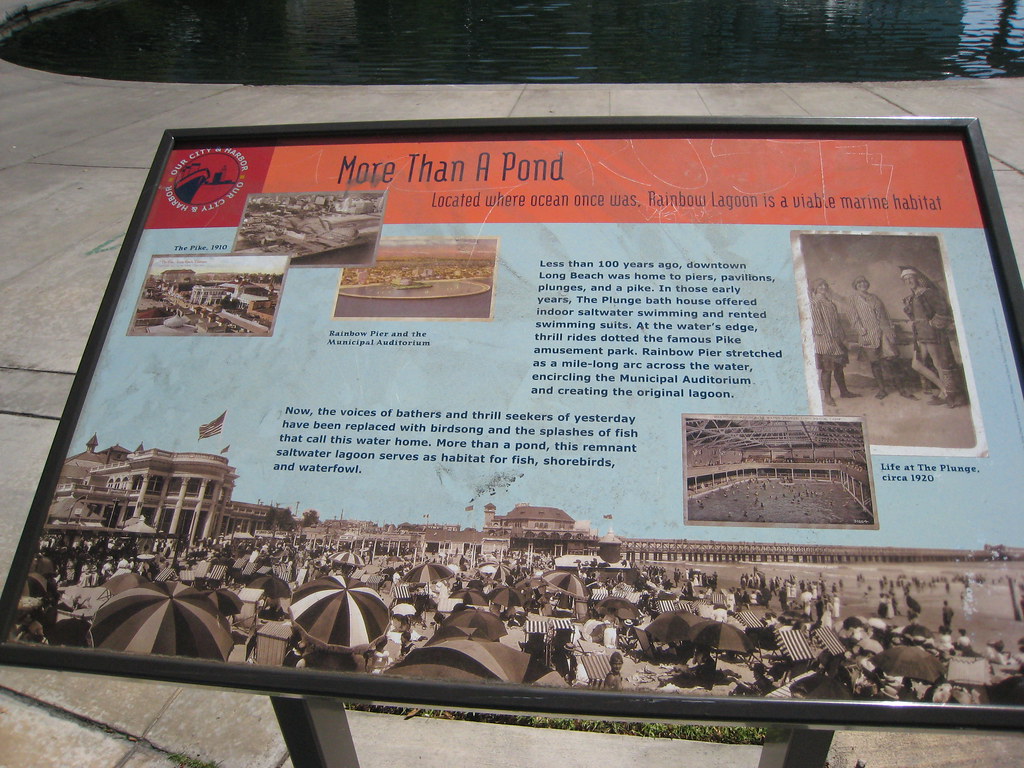
The park is much more welcoming for human inhabitants than wildlife. There is a beautiful winding path that take you over colorful bridges, and paddle boats to take you over the water. It is a lovely park, just not wondeful for wildlife, notwithstanding this semi-informative interpretive sign:
And, in the end, the park is far better than a sterile lawn in terms of wildlife. I came across a green heron (Butorides viriscens) catching a small fish in the lagoon! These guys aren't exactly rare, but nor are they that commonly seen.

Get ready for Coastal Cleanup Day 2007

Trash on our beautiful beach
Sunday, September 15, 2007 is California's Coastal Cleanup Day.
Why not devote half an hour to making Long Beach a more beautiful place? All you have to do is show up, and pick up trash you find along the beach.
Something is going on at nearly every stretch of the beach in Long Beach. In addition, there are inland sites along the Los Angeles River, and at the ponds in El Dorado Park. Remember: Trash anywhere on the strees in Long Beach will eventually wind up on the coast! So you can clean up the coast anywhere in the City. I'll post details about exact locations once they are known.
Coastal Cleanup Day is organized by the California Coastal Comission.
I participated in this event in 2006 at Alamitos Beach. So what did I think of it?
-Yes, it's kind of futile to think that one day of cleaning will have much of an impact. In fact, the beach didn't look any cleaner immediately after we finished.
-Some people don't quite get it. Some jerk dumped piles of moldy bread on the beach, and none of the volunteers thought it was littering until I pointed out to them that food on the beach attracts lots of rats.
-It's a great experience in self-education. There is FAR more litter on our beach than you might ever expect. And yes, it is all harmful to wildlife.
-It's a great public eductaion. If a man or woman sees hundreds of people cleaning up the beach, they may realize that the beach is something to value. Usually, people are ashamed to think someone else is cleaning up after them, and they will be more responsible with their own trash.
-They ask you to tally up all the pieces of trash you pick up. I think it's a waste of time and stupid. But for some people, it makes the task fun. I "guestimated" my numbers at the end. How many cigarette butts did you pick up? Eight billion?
By the way, they usually have awesome signs for the event. Last year's featured these cool wildlife cards:

The Cig-Egrett

The Spork Crab
Tuesday, August 21, 2007
Long Beach Water Department giving away grants for water-wise landscaping
The Long Beach Water Department is giving away grants up to $5000 to encourage home owners to replace water-hogging lawns with water-wise landscaping.
The announcement can be downloaded here.
The deadline is September 28, 2007.
The desired projects will require little water and maintenance, have minimal runoff, and provide wildlife habitat.
Although they do not require that projects use native plants (for shame! they do not even mention native plants!), a native garden would meet every single one of their goals (especially wildlife habitat).
The announcement can be downloaded here.
The deadline is September 28, 2007.
The desired projects will require little water and maintenance, have minimal runoff, and provide wildlife habitat.
Although they do not require that projects use native plants (for shame! they do not even mention native plants!), a native garden would meet every single one of their goals (especially wildlife habitat).
Monday, August 20, 2007
News: Fire at El Dorado Nature Center
The Press Telegram reports that firefighters put out a small fire near the Nature Center on the evening of August 19. [article]
Hot embers from an unknown source ignited the compost bin, although arson hasn't been ruled out.
However, damage to property appears to have been minimal, and none of the animals in the building were harmed.
Although brush fires were a historically common event in southern California, and most plants and animals are very well adapted to it, the small size of El Dorado park means that wildlife are very vulernable to fires here. A large enough blaze could wipe out an entire population
Hot embers from an unknown source ignited the compost bin, although arson hasn't been ruled out.
However, damage to property appears to have been minimal, and none of the animals in the building were harmed.
Although brush fires were a historically common event in southern California, and most plants and animals are very well adapted to it, the small size of El Dorado park means that wildlife are very vulernable to fires here. A large enough blaze could wipe out an entire population
Thursday, August 16, 2007
Update
I haven't done much on this blog in a long time. I have already covered most of the parks in Long Beach that contain significant natural areas (although there are quite a few, especially on the LA River, I have yet to visit!). I will continue to cover them, but in the future, this blog will expand to cover a variety of environmental issues affecting Long Beach and surrounding communities, especially those affecting Parks and natural habitats.
I hope you enjoy!
I hope you enjoy!
Thursday, July 5, 2007
Cha'wot Nature Preserve (Signal Hill)
Note: Location is approximate and not yet determined
Due to its small size, population density, and prolific oil industry, Signal Hill hardly retains any undeveloped open space. A few areas containing oil wells may one day become parks once the wells run dry, but few of these areas hold any promise for wildlife.

One exception is a 30-acre parcel on the north slope of Signal Hill. This property is currently owned by Signal Hill Petroleum and is strictly off-limits to the public due to safety concerns. The City, in conjuction with the Trust for Public Lands begun talks with the petroleum company to purchase the land. Everything is still in the early planning stages, and the final size/shape/appearance of the park has yet to be determined. The San Gabriel and Lower Los Angeles River and Mountains Conservancy has conducted some of the studies that are necessary to turn this once-productive oil field into a park.
The name "Cha'wot" comes from the word used by the indigenous Tongva people to mean "signal-fire," referring to the signals used by the village in Long Beach (Puvungna, now the campus of Cal State Long Beach) to communicate with neighbors on Catalina Island and the Palos Verdes Peninsula.
You can take a look at the future site of the park from Combellack Drive. From the street, the slopes appear to be dominated by nonnative trees and grasses. The Long Beach chapter of the Sierra Club has spotted more than 70 species of birds among the eucalypts trees, but it is unclear if a thorough assessment of the biological resources has been done. You can read about their work on this project in past issues of their newsletter.

The entryway doesn't say "Welcome", but it doesn't say "Unwelcome" either.... Still, best not to tresspass.
What do they have in mind? Maybe a woodland? Some sage-scrub? I imagine the tall eucalyptus are staying, but I wonder how much of the exotic vegetation they plan on removing....
Some of the prettier (but non-native) flowers from the site:

Moss verbena (Verbena tenuisecta), from South America.

Gazania (Gazania linearis), from South Africa
Subscribe to:
Posts (Atom)